Wednesday, January 23, 2008
Just a Fad?
Last Sunday, writing in The New York Time's Week in Review, Andrew C. Revkin explored the faddishness of purchasing credits to offset your carbon-footprint. The article is headlined "Carbon-Neutral is Hip, but is the Green?" To me, the most interesting part of the article was this quote from Charles Komanoff, an energy economist in New York: "There isn't a single American household above the poverty line that couldn't cut their CO2 at least 25 percent in six months through a straightforward series of simple and terrifically cost-effective measures." Strangely, the Times doesn't give Komanoff the opportunity to tell us what those measures are. Well, I'm curious enough to track Komanoff down and ask him. I'll let you know what he has to say. In the meantime, what do you think: Is purchasing carbon credits a useful tool, or a silly fad?


Amazon's Kindle is Eco?
The launch of Amazon's Kindle was widely reported in the media today in articles like this one from The New York Times: Amazon Reading Device Doesn't Need Computer. Perhaps that's because the e-reader will offer subscriptions to newspapers like the Times that are desperately searching for new revenue streams.
Missing from the coverage was any analysis of the green aspects of the new device. What's clear is that book publishing has plenty of room for improvement. According to Eco-Libris, only 5% of books published in the United States are printed on recycled paper. The same Web site says that about 20 million trees are cut down each year to print books.
If the Kindle can save a fraction of those trees -- not to mention the environmental costs of bleaching and transporting the paper -- I say it's worth considering, even if the $399 asking price is rather steep.
Of course, the Kindle and other ereaders can never really replace the book. Can they?
http://www.ksg.harvard.edu/presspol/research_publications/papers/discussion_papers/D39.pdf
Missing from the coverage was any analysis of the green aspects of the new device. What's clear is that book publishing has plenty of room for improvement. According to Eco-Libris, only 5% of books published in the United States are printed on recycled paper. The same Web site says that about 20 million trees are cut down each year to print books.
If the Kindle can save a fraction of those trees -- not to mention the environmental costs of bleaching and transporting the paper -- I say it's worth considering, even if the $399 asking price is rather steep.
Of course, the Kindle and other ereaders can never really replace the book. Can they?
http://www.ksg.harvard.edu/presspol/research_publications/papers/discussion_papers/D39.pdf

Friday, June 1, 2007
Brown Water?
I just spoke to the town Sewer department. Since we moved into the house three weeks ago, I've noticed that the water from some the taps is brown. Since the house was empty for nearly a year, I wasn't surprised that some sediment would have gathered. I hoped that the problem would resolve itself with time as any sediment present in the pipes flushed out. The woman at the Sewer department said that if the HOT water was brown, we may need a new hot water heater. Another item to research: What is the most energy efficient system? I am intrigued by tankless heaters.
Wednesday, August 16, 2006
Exterior Painting
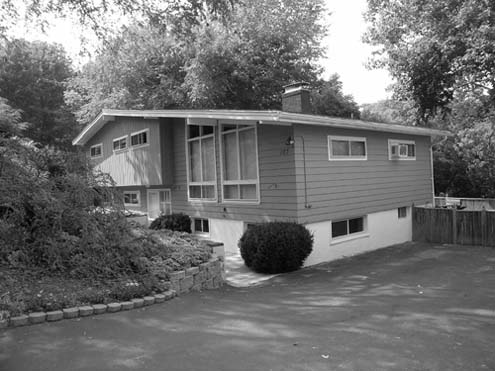
It's time to think about repainting the exterior of the house.
Using Angie's List as a starting point, I identified three local companies with excellent reputations to give us a quote on the job: Olde England Painting, Eagle Painting, and Professional Partners. Eric and I had already done some preliminary research on green paint options, and found them rather limited. More on that a bit later.
The first painter out to the house was Gavin of Olde England. He came by on 8/16 and gave the house a careful and thoughtful lookover, and made some thoughtful suggestions on the use of color. (Suggesting, for example, that the house would look bigger if we painted the parts that are currently blue a light green shade of our choice, and the white parts of the foundation a slighter darker version of the same color.) He also suggested adding a bit of the green to the trim color to help the colors go together better. He said the house needed to be scrapped and sanded in preparation for painting. I asked if the exisiting paint may contain lead. If lead paint is sanded, that lead could contaminate the soil in the yard. He said they put down cloths to contain the sandings and emphasized that sanding was essential for a good outcome.
The house was built in 1960. The government banned the use of lead-based paint in residential environments in 1978, which means there was 18 years during which the house may have been painted with lead-based paint. I'm going to consider doing a lead test before allowing Gavin to get busy with a sander. We should also have his quote in a few days.
Using Angie's List as a starting point, I identified three local companies with excellent reputations to give us a quote on the job: Olde England Painting, Eagle Painting, and Professional Partners. Eric and I had already done some preliminary research on green paint options, and found them rather limited. More on that a bit later.
The first painter out to the house was Gavin of Olde England. He came by on 8/16 and gave the house a careful and thoughtful lookover, and made some thoughtful suggestions on the use of color. (Suggesting, for example, that the house would look bigger if we painted the parts that are currently blue a light green shade of our choice, and the white parts of the foundation a slighter darker version of the same color.) He also suggested adding a bit of the green to the trim color to help the colors go together better. He said the house needed to be scrapped and sanded in preparation for painting. I asked if the exisiting paint may contain lead. If lead paint is sanded, that lead could contaminate the soil in the yard. He said they put down cloths to contain the sandings and emphasized that sanding was essential for a good outcome.
The house was built in 1960. The government banned the use of lead-based paint in residential environments in 1978, which means there was 18 years during which the house may have been painted with lead-based paint. I'm going to consider doing a lead test before allowing Gavin to get busy with a sander. We should also have his quote in a few days.
Thursday, June 15, 2006
Tree Assessment
Eric and I met with an arborist to walk the property in June of 06. We learned as much as possible about the types of trees that are present on the property and what needs to happen to keep them healthy. Our expert guide was Joe Alongi from Boston Tree Preservation, a company that embraces an organic approach to tree care. The news wasn't all that good. Winter moths have severely injured several trees on the property. In addition, Joe found evidence of three additional pests that have been wrecking havoc in the yard. It's a jungle out there!
Subscribe to:
Comments (Atom)